For some time now, we’ve been helping our clients build strong CRM strategies through Klaviyo, with email typically serving as the central pillar. With the introduction of WhatsApp within Klaviyo, a new opportunity emerged to expand this approach with a more direct, personal and engaging channel.
The first results clearly demonstrate its potential. Rather than being just another standalone channel, WhatsApp can become a structural complement to email and a valuable revenue driver within the broader CRM strategy.
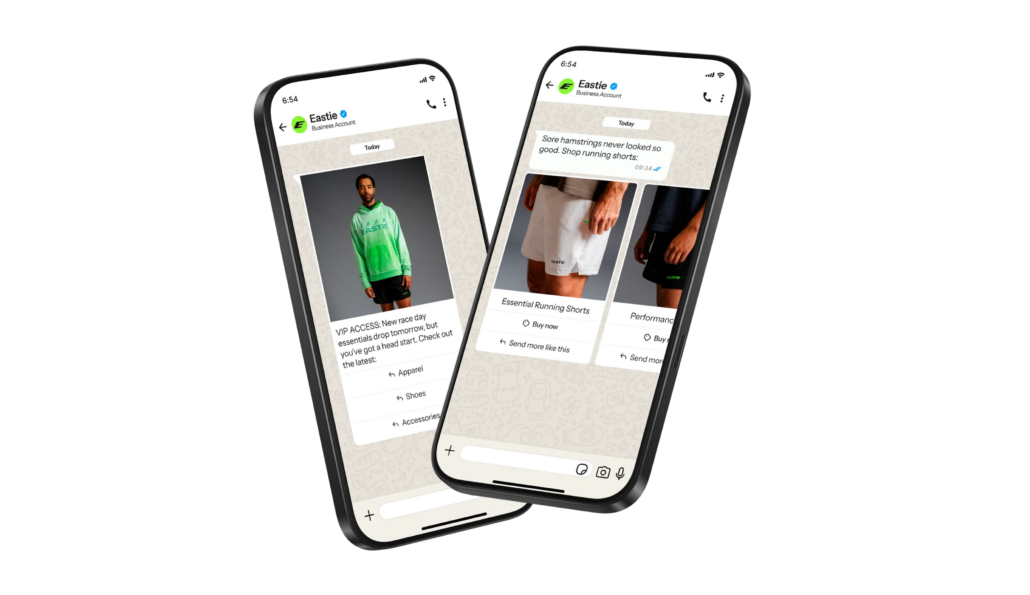
WhatsApp in Klaviyo. Bron: Klaviyo
One Database, Another Touchpoint
The power of WhatsApp isn’t about simply communicating more. It’s about creating an additional touchpoint
to engage customers and subscribers in a highly targeted way.
However, building this channel requires a gradual and controlled approach. Not everyone in an existing email database has shared their phone number or given consent to receive WhatsApp communications. Building a high-quality WhatsApp subscriber base therefore takes time.
Test First, Scale Later
A successful WhatsApp strategy starts with relevant, warm audiences. Think existing customers, loyal subscribers or people who have already shown a clear interest in the brand.
From there, the channel can gradually be scaled to broader segments and different moments throughout the customer journey.
This allows WhatsApp to evolve from a one-off campaign into a channel with its own distinct role alongside email: shorter, more direct and closer to the customer.
Smaller Audience, Stronger Impact
Because WhatsApp often starts with a smaller but more engaged audience, we see that the channel can deliver strong results in terms of engagement and conversion.
Results naturally vary by brand, audience and campaign, but in practice, we often see open rates well above 60%
and click rates reaching approximately 10–15%.
By comparison, email click rates typically range between 5–7%.
We also see significant differences in conversion. In one of our client projects, WhatsApp achieved conversion rates up to 10x higher than email
for comparable campaigns.
These figures aren’t a guarantee for every campaign, but they clearly illustrate the channel’s potential. WhatsApp reaches customers more directly, feels more personal and is typically used to engage audiences who already have a strong interest in the brand.
Especially when used for relevant moments such as product launches, restocks, exclusive offers or targeted reminders, WhatsApp can make a meaningful contribution to revenue.
In one of our client projects, we also saw WhatsApp revenue increase significantly within a short period, growing by several hundred percent. Today, the channel accounts for approximately 10% of monthly revenue generated through Klaviyo in that project.
The key takeaway isn’t that WhatsApp will always deliver the same results, but that it can become a powerful complement to email. By strategically integrating WhatsApp into the broader CRM approach, brands create additional opportunities to engage customers faster, more personally and more relevantly.
From Additional Channel to an Integral Part of CRM
The biggest opportunity doesn’t lie in using WhatsApp as a one-off activation, but in establishing it as a structural part of the CRM strategy.
Beyond campaigns, WhatsApp can be activated at different stages of the customer journey: from exclusive launches and restocks to abandoned carts, personalized recommendations and reactivation.
The key learning?
Not every channel needs to serve the same purpose. Email creates room for more in-depth storytelling and product inspiration, while WhatsApp is particularly effective for exclusivity and personalized engagement.
The next step is therefore to stop treating WhatsApp as a standalone channel and start integrating it into a broader multi-channel CRM strategy, where every touchpoint has its own distinct role.
From Email-First to Multi-Channel CRM
Ready to take your CRM strategy to the next level? At The Dot, we help e-commerce brands evolve from an email-first strategy to an integrated multi-channel approach where email, SMS and WhatsApp reinforce each other, driving engagement, stronger customer relationships and revenue growth.
This post is also available in:





